Movement & Exercise Foundations · Atlas Library article
Walking for Health
Walking is an adjustable, accessible way to build regular movement into daily life.
Atlas Confidence: Moderate
Current evidence supports this conclusion, but meaningful uncertainty or limitations remain. Future research could change the interpretation.
What does this mean?
Why this article has this rating
A large body of evidence associates regular physical activity, including walking, with health and function, but the best dose and attainable benefit vary by person and outcome.
How Atlas is different
Every Atlas article explains how strongly the current body of evidence supports its conclusions. Rather than presenting every recommendation as equally certain, Atlas uses transparent confidence ratings that evolve as scientific understanding develops.
Atlas Confidence reflects the strength of the current body of evidence supporting an educational conclusion. It is not absolute certainty, a guarantee of an individual outcome, or a substitute for professional clinical judgment.
Walking is an accessible way for many people to build regular movement into daily life. Health benefits can begin below the full weekly activity target. A useful starting amount is safe, tolerable, and repeatable; pace, time, frequency, terrain, and recovery can then be adjusted gradually.
Understand Why · About 1 minute
Build the complete picture.
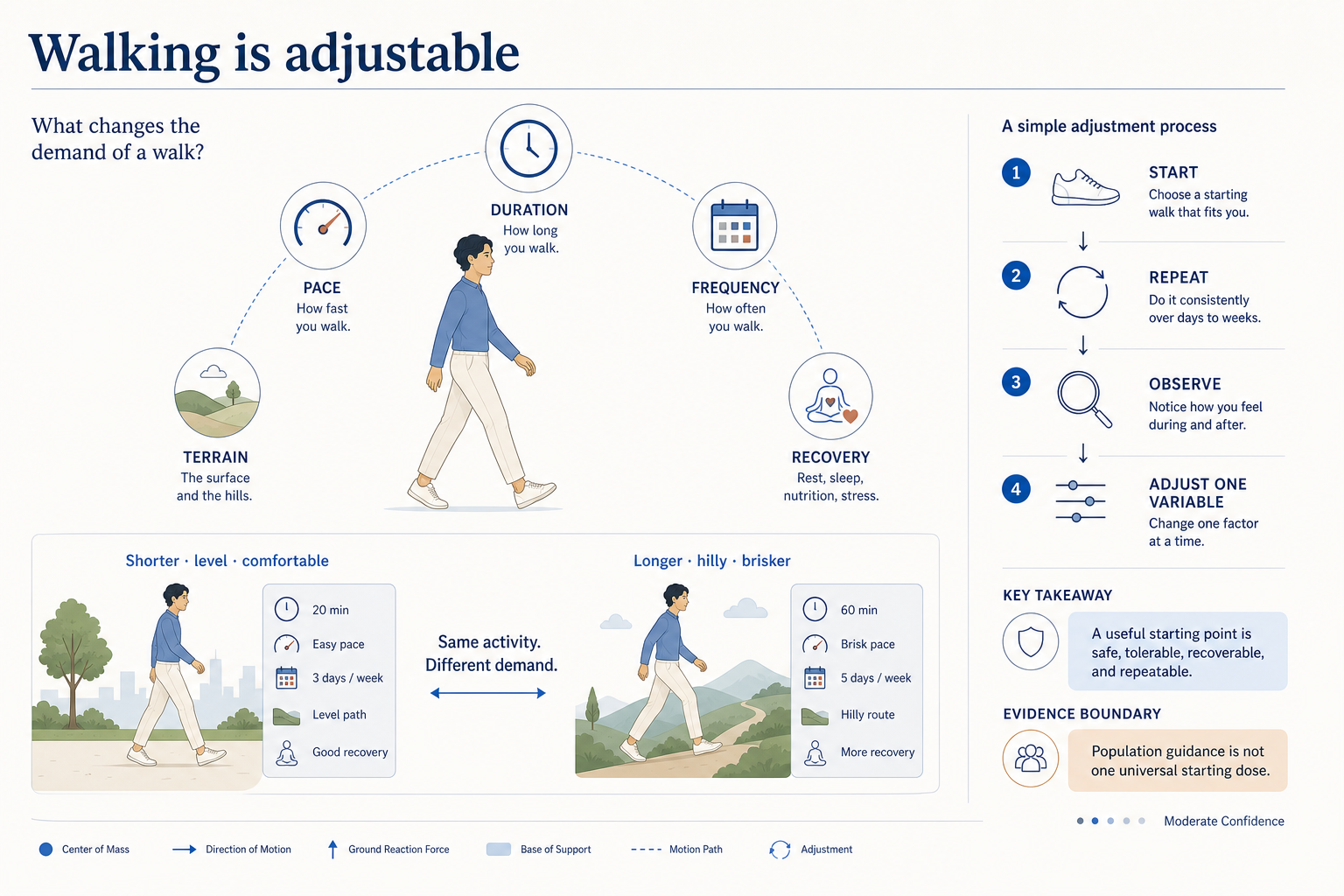
Walking is not one fixed exercise dose. A five-minute walk on level ground and a long brisk walk over hills create different demands. This adjustability lets people begin from their present capacity rather than from an idealized standard.
Consistency matters because health effects develop through repeated exposure. Short walks can contribute, and activity can be accumulated across the week. Progress may mean adding time, increasing pace, walking more often, or becoming more comfortable at the same dose. Changing one variable at a time makes the response easier to understand.
Walking also exists in context. Safe routes, weather, footwear, symptoms, disability, time, and social support influence what is realistic. A plan that works on paper but cannot be repeated in daily life is not yet a useful plan.
For example: someone beginning with ten comfortable minutes after lunch might first repeat that walk on several days. If recovery remains acceptable, the next change could be a few additional minutes or a slightly quicker pace—not both at once.
Practical orientation
- Some walking is more useful than waiting for a perfect dose.
- Consistency and recovery matter more than one unusually good or difficult walk.
- Progress can come from changing time, pace, frequency, or terrain one variable at a time.
Open Evidence & Clinical PerspectiveSources, limitations, and clinical boundaries · About 1 minute
Evidence
U.S. and World Health Organization guidance supports regular aerobic activity and emphasizes that some activity is better than none. The familiar target of 150–300 minutes of moderate-intensity activity per week describes a broad population goal, not a mandatory entry dose or a guarantee of benefit.
Evidence spans many outcomes and study designs. It more strongly supports walking and other activity as contributors to health than it supports a single universal prescription. Observational associations can also reflect differences between people who are more and less active, so individual claims should remain bounded.
Clinical Perspective
Begin with an amount that can be recovered from and repeated. Sudden chest pressure, fainting, severe unexplained breathlessness, new neurological symptoms, or a rapid and meaningful decline in function require a different response than ordinary exertion. People with significant health concerns may need individualized guidance before changing activity substantially.
A large body of evidence associates regular physical activity, including walking, with health and function, but the best dose and attainable benefit vary by person and outcome.
Atlas Confidence rationale: This rating reflects the strength and consistency of the current body of evidence supporting this educational conclusion, together with the limitations described above.
This page provides general education, not diagnosis or an individualized prescription. New trauma, marked swelling, progressive neurological symptoms, or major functional loss warrant timely clinical assessment.
Key Takeaways
What to carry forward.
- Some walking is more useful than waiting for a perfect dose.
- Consistency and recovery matter more than one unusually good or difficult walk.
- Progress can come from changing time, pace, frequency, or terrain one variable at a time.
References
- U.S. Department of Health and Human Services. Physical Activity Guidelines for Americans, 2nd edition. 2018.Supports the bounded evidence statements and limitations presented in this article.
- World Health Organization. WHO guidelines on physical activity and sedentary behaviour. 2020.Supports the bounded evidence statements and limitations presented in this article.
Update history Publication and maintenance record
August 2026 — Foundational working draft created; independent review pending.
August 2026 — Independent editorial verification accepted; publication remains unauthorized.